The question of whether astrology is true remains one of the most contentious topics at the intersection of spirituality, science, and human psychology. The straightforward answer from the scientific community is definitive: astrology has no scientific validity and is classified as pseudoscience. However, this answer obscures a far more nuanced reality. While mainstream science rejects astrology's core claims about celestial influence on human affairs, millions of people worldwide find profound value in astrological practices for self-discovery, decision-making, and psychological well-being. The truth about astrology lies not in a simple yes or no, but in understanding what astrology actually claims, why it persists despite scientific rejection, and what genuine value it may offer beyond empirical validation.
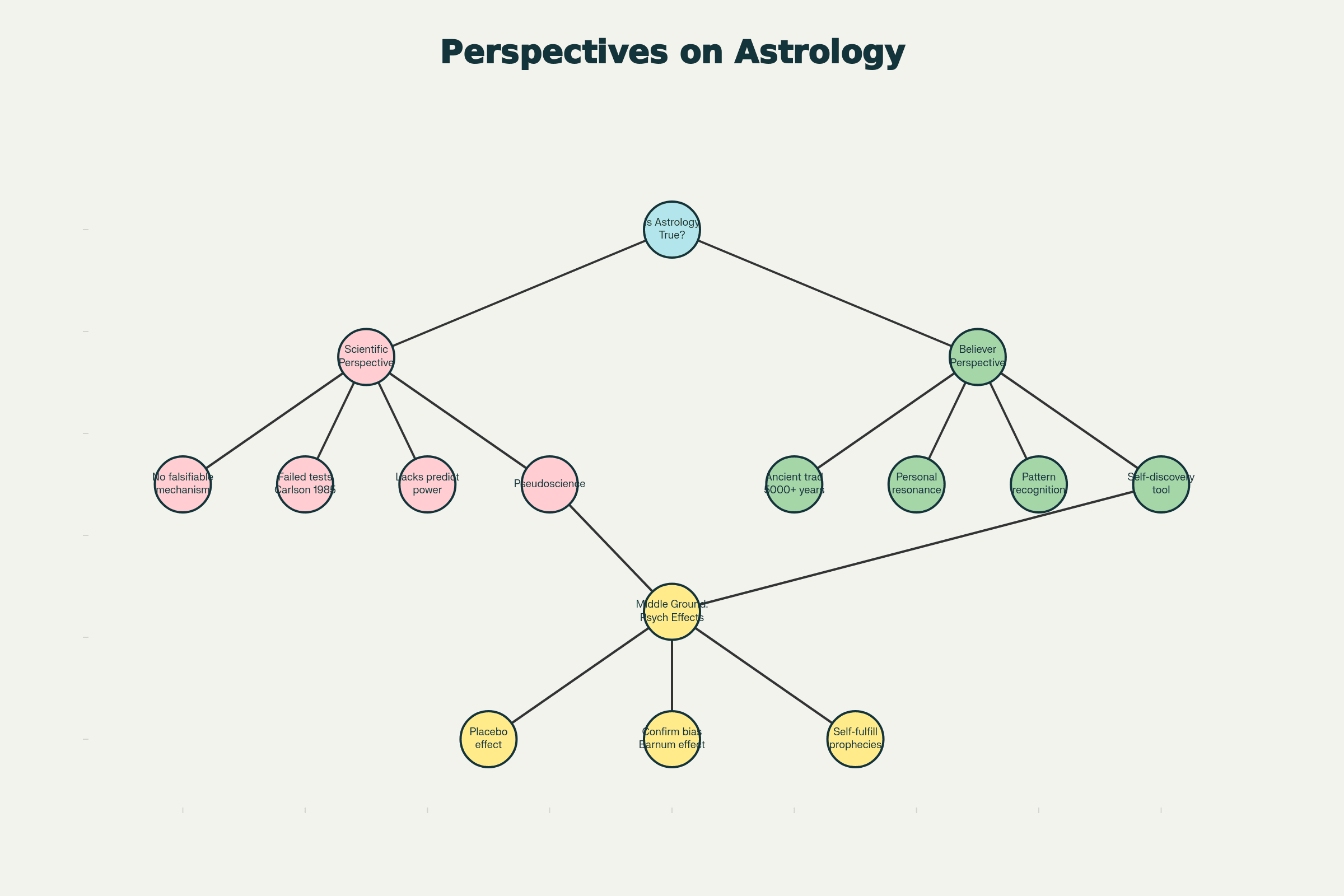
Different Perspectives on Astrology: Scientific Skepticism vs. Believer Support
The Scientific Case Against Astrology
Lack of Plausible Mechanism
The most fundamental criticism of astrology from a physics and biology perspective is that there is no known mechanism by which the positions of distant planets could influence human personality, events, or destiny. The gravitational force exerted by planets is negligible at human scales—a hospital delivery room light exerts more gravitational influence on a newborn than any celestial body. Moreover, the electromagnetic radiation from planets is indistinguishable from many terrestrial sources. Any influence mechanism proposed by astrologers would contradict well-established principles of biology and physics. This absence of a plausible causal pathway between planetary positions and human outcomes remains one of the strongest scientific objections to astrology.
Controlled Experimental Failures
The most famous scientific test of astrology was conducted by physicist Shawn Carlson in 1985, published in the prestigious journal Nature. Carlson's double-blind experiment was remarkable for its collaboration between scientists and astrologers—astrologers actually helped design the study to ensure fairness. In the experiment, 28 astrologers were asked to match over 100 natal charts to personality profiles generated by the California Psychological Inventory questionnaire. The results were unambiguous: astrologers performed no better than random chance. Subsequent replications and variations of this experiment have yielded similar results. In one notable study, researchers examined the personality and intelligence test results of 15,000 people and found no correlation between date of birth and personality traits.
Beyond the Carlson study, a comprehensive analysis of scientific research reveals a consistent pattern: across several centuries of testing, the predictions of astrology have never been more accurate than expected by chance alone. When astrologers are tested under rigorous experimental conditions with clear, falsifiable predictions, they fail to demonstrate any genuine predictive or interpretive ability. This repeated experimental failure stands in stark contrast to validated scientific disciplines, where theories are refined and improved based on empirical evidence.
The Problem of Unfalsifiability
One of the defining characteristics of pseudoscience is the inability or unwillingness to modify claims in response to falsifying evidence. Astrology exhibits precisely this characteristic. Unlike science, which explicitly seeks to disprove hypotheses through testing, astrology has remained largely unchanged despite repeated experimental failures. When predictions fail, astrologers typically revise interpretations retroactively rather than abandoning the system. Furthermore, astological predictions are often deliberately vague—phrased in language that can be interpreted to match virtually any outcome. This built-in flexibility makes astrology unfalsifiable: any event can be claimed as confirmation, and failed predictions can always be reinterpreted as metaphorical or misunderstood.
Internal Inconsistencies
Scientific examination reveals fundamental inconsistencies within astrological systems themselves. For instance, there is no consensus among astrologers about what astrology actually is or what it can predict—Dean and Kelly documented that the degree of agreement among astrologers' predictions measured only 0.1 on a scale where 1.0 would indicate perfect agreement. This lack of internal consistency suggests that astrology operates more as an interpretive art than as a systematic science. Additionally, Western astrology's tropical zodiac system is disconnected from the actual constellations it claims to represent. The constellations have shifted significantly since ancient times due to the precession of Earth's axis, yet Western astrology has not adjusted its zodiacal boundaries to match the current sky. When Ophiuchus was discovered as a thirteenth constellation, Western astrology simply ignored it rather than revising its foundational framework.
Debunking the Defenses: Revisiting the "Evidence"
The Gauquelin Mars Effect: A Flawed Foundation
Proponents of astrology often cite Michel Gauquelin's "Mars Effect" as evidence supporting astrological claims. Gauquelin reported finding statistically significant correlations between Mars placements and athletic eminence, which advocates hailed as proof of astrology's validity. However, subsequent scholarly investigation has thoroughly undermined this claim. Later research, particularly by skeptic astronomer Dennis Rawlins and others, identified massive selection bias and methodological flaws in Gauquelin's data collection. Gauquelin appears to have preferentially selected data supporting his hypothesis while excluding data that contradicted it. When independent researchers attempted to replicate his findings with more rigorous protocols, the Mars effect disappeared. This case exemplifies how apparent statistical evidence for astrology dissolves under closer scrutiny—a pattern repeated throughout the scientific literature on astrology.
Why People Believe: The Psychology of Astrology
Confirmation Bias and the Barnum Effect
Perhaps the most powerful explanation for astrology's apparent accuracy lies not in astrology itself, but in human psychology. Confirmation bias—the tendency to seek, interpret, and remember information that confirms preexisting beliefs while ignoring contradictory evidence—plays a central role in sustaining belief in astrology. People remember the instances when a horoscope seemed accurate and forget the numerous times it proved wrong. This selective memory is reinforced by the Barnum effect (also called the Forer effect), where people accept vague, general statements as specifically describing them. Statements like "you are often critical of yourself" or "you sometimes feel misunderstood" are universally true, yet people attribute them to their personal astrological profiles. Research specifically analyzing horoscope text has found that astrological language is deliberately constructed with vague, feel-good statements that trigger confirmation bias.
Pattern Recognition and Meaning-Making
Humans evolved powerful pattern recognition abilities—a cognitive trait essential for survival in ancestral environments. However, this same tendency leads us to see meaningful patterns even where none exist, a phenomenon known as apophenia. Astrology leverages this deeply human tendency to seek patterns and explanations for events. When difficult things happen and someone has been told by their horoscope that challenging times were coming, they experience the horoscope as prescient, even though challenging times are a universal human experience. This natural human drive to make sense of chaos through narratives explains much of astrology's psychological appeal independent of its literal truth.
The Need for Meaning and Spirituality
A significant factor in astrology's persistence is the human need for meaning, purpose, and spiritual connection. In an increasingly secular world, astrology provides what Monisha Pasupathi, a developmental psychologist at the University of Utah, describes as "a very clear frame for explanation"—a coherent narrative through which to understand one's identity, choices, and place in the universe. People are drawn to astrology's symbolism, mythology, and cosmic framing as a way to explore their identities and find guidance. This need is deeply human and legitimate, even if the vehicle providing it lacks scientific validity. For many, astrology functions psychologically similarly to how religion functions for others—as a source of meaning, community, and existential comfort.
The Rise of Astrology Among Gen Z
In contemporary culture, astrology has experienced a dramatic resurgence, particularly among Generation Z. This phenomenon reveals important insights about astrology's appeal. Astrology-related hashtags have garnered billions of views on social media platforms like TikTok and Instagram, with young people using astrological language to discuss personality, relationships, and life decisions. Researchers identify multiple factors driving this trend: astrology offers self-discovery tools in an era of identity exploration; it provides psychological comfort and a sense of agency amid economic uncertainty and climate anxiety; it creates community and belonging through shared cosmic language; and crucially, it presents itself as a data-driven system with calculation methods and measurable degrees and aspects, appealing to analytically-minded young people who are comfortable with both logic and intuition. Social media's algorithm-driven distribution of bite-sized astrology content—memes, short videos, personalized readings—has transformed astrology from a niche practice into mainstream pop culture.
The Psychological and Cultural Benefits of Astrology
The Placebo Effect and Positive Outcomes
Research published in Personality and Individual Differences has documented a genuine placebo effect from horoscopes. When people read positive horoscopes, they unconsciously form expectations and subsequently behave in ways that make those predictions more likely to occur. This is not deception—it's a documented psychological phenomenon where expectation shapes behavior and outcomes. People who read that a promotion is in their future approach their work with greater confidence and visibility, increasing the likelihood of recognition. The brain "sees" the prediction and kicks into overdrive to help make it reality. While this mechanism doesn't validate astrology's truth claims, it demonstrates a genuine benefit: astrology can function as a low-pressure psychological intervention that increases motivation, optimism, and positive self-perception.
Self-Fulfilling Prophecies and Personal Agency
Self-fulfilling prophecies represent another mechanism through which astrology produces apparent accuracy independent of literal truth. If someone believes they are creative, curious, and bold because their birth chart indicates this, they are more likely to notice and pursue creative opportunities. They interpret ambiguous situations as validating their astrological profile. Importantly, self-fulfilling prophecies can be powerfully positive. Someone told they will have a successful day approaches challenges with greater confidence, increasing the likelihood of actual success. While this mechanism reveals that astrology's apparent accuracy may not reflect actual cosmic influence, it also indicates that astrology can serve as a framework for positive self-concept development.
Psychological Benefits Beyond Accuracy
Several documented psychological benefits of astrology exist independent of whether astrology is literally true:
Self-awareness and introspection: Exploring one's birth chart encourages deep self-reflection and examination of personal traits, goals, and patterns. This self-examination has therapeutic value regardless of astrology's empirical validity.
Meaning-making and narrative integration: Astrology provides frameworks for understanding one's past, present, and future as part of coherent narratives. This meaning-making capacity reduces existential anxiety and promotes psychological well-being.
Stress management and uncertainty tolerance: Astrology helps individuals manage fear of the unknown by offering explanations and predictions, providing structure and predictability. In uncertain times, this perceived order provides genuine comfort.
Community and belonging: Astrology creates communities of shared beliefs and language, fostering social bonding and reducing isolation. The social support derived from these communities has documented mental health benefits.
Hope and optimism: Astrological frameworks often emphasize future possibilities and positive potential, fostering hope and motivation toward personal goals.
Research on spirituality more broadly confirms that spiritual practices—whether grounded in empirical reality or not—can support mental health, resilience, and well-being when practiced constructively.
The Distinction Between Literal Truth and Psychological Value
Why the Scientific Consensus Matters
It is crucial to acknowledge that while astrology offers psychological and cultural value, the scientific community's rejection of astrology as having no empirical validity is correct and important. Science, as a method for understanding the physical world, has consistently and repeatedly failed to find evidence that astrology works as claimed. This matters for several reasons. First, it prevents the misallocation of resources and time to pursuing astrological explanations when evidence-based approaches might be more effective. Second, it maintains the integrity of science as a self-correcting system grounded in empirical evidence. Third, uncritical belief in astrology can lead to decision-making that ignores evidence and relies on superstition. Someone might delay seeking medical treatment because their horoscope suggested delays, or make poor financial decisions based on planetary transits.
The Value of Honest Acknowledgment
The healthiest approach to astrology involves honest acknowledgment of both its lacks and its benefits. Astrology, from a scientific perspective, has no demonstrated mechanism, fails controlled tests, and lacks the internal consistency of legitimate scientific systems. These are facts. Simultaneously, astrology can provide genuine psychological benefits—fostering self-reflection, meaning-making, community, and hope—benefits that exist independent of literal truth. People can find value in astrology while maintaining intellectual honesty about its scientific status. This parallels how some people find value in fiction, mythology, or metaphor—these need not be literally true to be meaningful and beneficial.
Different Astrological Traditions: Comparative Analysis
Vedic vs. Western Astrology
The question of astrology's truth becomes more complex when considering different astrological traditions. Vedic astrology (Jyotish), based on ancient Indian texts and the sidereal zodiac, claims greater accuracy than Western astrology for predictive purposes. Vedic astrology employs more complex mathematical calculations, includes additional systems like Nakshatras (27 lunar mansions) and Dashas (planetary periods), and analyzes divisional charts for more nuanced interpretation. Proponents argue this greater complexity enables more precise predictions than Western astrology.
However, the scientific critique applies equally to Vedic astrology: there are no rigorous, controlled studies demonstrating that Vedic astrology's predictions significantly exceed chance. While case studies and anecdotal evidence abound, and many individuals report resonance with Vedic readings, the absence of controlled experimental validation mirrors the scientific failure of Western astrology. The greater complexity of Vedic systems might make them appear more credible or sophisticated, but greater complexity does not equal greater empirical validity. Indeed, the untestable nature of Vedic astrology's interpretive framework renders it more resistant to falsification rather than more scientifically rigorous.
Cultural Contexts and Varying Accuracy Claims
Chinese astrology, based on the lunar calendar and animal signs, operates on entirely different principles than Western or Vedic systems yet commands its own devoted following. The subjective experience of accuracy varies based on cultural background, personal belief systems, and how well the symbolism resonates with lived experience. Someone raised in a culture where Chinese astrology is embedded may find it more resonant than Western astrology, not because it is objectively more accurate, but because the cultural context makes the symbolism more meaningful. This observation further supports the interpretation that astrology's perceived accuracy derives more from psychological and cultural factors than from objective celestial influence.
The Verdict: Is Astrology True?
The Scientific Answer
From a scientific perspective, the answer is unambiguous: astrology is not true as a literal description of how the universe works. Astrology lacks a plausible mechanism, fails controlled tests, remains internally inconsistent, and persists unchanged despite empirical disconfirmation. The scientific community's classification of astrology as pseudoscience reflects these facts. This conclusion, while sometimes unpopular, remains well-supported by evidence.
The Practical and Psychological Answer
However, in practical and psychological terms, the answer is more nuanced. Astrology can be genuinely useful and valuable as a tool for self-reflection, meaning-making, community-building, and psychological motivation. These benefits exist not because astrology is empirically true, but because of well-documented psychological mechanisms like the placebo effect, self-fulfilling prophecies, and confirmation bias. People who use astrology as a framework for self-discovery and decision-making may experience genuine benefits—not because the stars actually determine destiny, but because they have engaged in deep self-reflection and approached life with greater intentionality and optimism.
The Honest Conclusion
Perhaps the most intellectually honest conclusion is this: Astrology is not scientifically true—it lacks empirical evidence, plausible mechanism, and passes no rigorous tests. Simultaneously, astrology can be psychologically beneficial and culturally meaningful for those who engage with it consciously and constructively. This middle position acknowledges both the scientific facts and the real experiences of people who find value in astrological practices.
Recommendations for Engaging with Astrology Responsibly
For those interested in astrology, several principles support responsible engagement:
- Maintain Intellectual Honesty: Acknowledge astrology's lack of scientific validity while appreciating any psychological benefits you derive from it.
- Use Astrology as a Tool, Not a Truth: Treat astrology as one perspective among many, a framework for reflection rather than a source of certain knowledge.
- Supplement, Don't Replace: Use astrology to supplement—not replace—evidence-based approaches to health, career, and life decisions.
- Seek Quality Interpretation: If consulting astrologers, seek those who encourage critical thinking and personal agency rather than rigid adherence to predictions.
- Monitor for Harmful Beliefs: Be alert to ways astrology might foster fatalism, self-limiting beliefs, or excuse-making that hinders growth.
- Engage Community Consciously: Use astrology-based communities for meaningful connection while maintaining awareness of potential for groupthink and confirmation bias.
Conclusion
The question "Is astrology true?" cannot be answered with a simple yes or no. From the scientific perspective, astrology is demonstrably not true—it lacks mechanism, fails tests, and remains pseudoscientific by rigorous standards. This conclusion is important and should inform decisions about significant life choices. However, this scientific reality coexists with another truth: that millions of people find genuine psychological, cultural, and spiritual value in astrological frameworks. These benefits are real, though they derive from psychology and meaning-making rather than from literal cosmic influence.
The future of astrology likely lies in this middle ground—honest integration that acknowledges both scientific reality and psychological value. Rather than demanding that people choose between scientific accuracy and meaningful practice, we might encourage people to engage astrology consciously and constructively, appreciating its value for self-discovery and community while maintaining clear-eyed recognition that the stars do not determine our destinies. In an increasingly secular world searching for meaning, astrology serves important psychological functions. The responsible approach is to access these benefits while maintaining intellectual honesty about the limits of astrology's truth claims. This represents neither blind skepticism nor uncritical belief, but a mature integration of both reason and the very human need for meaning.
References
- https://en.wikipedia.org/wiki/Astrology_and_science
- https://en.wikipedia.org/wiki/Astrology
- https://www.wtamu.edu/~cbaird/sq/2013/03/23/how-does-astrology-work/
- http://www.skepticalmedia.com/astrology/Scientific%20Inquiry%20into%20Astrology.pdf
- https://www.bbcearth.com/news/is-astrology-backed-by-science
- https://undsci.berkeley.edu/lessons/pdfs/astrology_checklist.pdf
- https://www.strikemagazines.com/blog-2-1/im-scared-of-how-accurate-astrology-is
- https://ijamjournal.org/ijam/publication/index.php/ijam/article/download/97/94
- https://ua.pressbooks.pub/pseudoscienceessays/chapter/a-misleading-theory-the-pseudoscience-behind-astrology/
- https://www.reddit.com/r/AskPhysics/comments/1gh4uyn/why_doesnt_astrology_work_in_terms_of_physics/
- https://numrovani.com/is-astrology-really-accurate-what-science-skeptics-dont-want-you-to-know/
- https://skepsis.nl/mars-effect/
- https://cyclesresearchinstitute.org/subjects/cycles-astrology/gauguelin/
- https://en.wikipedia.org/wiki/Mars_effect
- https://www.reddit.com/r/astrology/comments/o9nrmt/does_astrology_have_any_science_driven/
- https://www.betterhelp.com/advice/general/why-do-people-believe-in-astrology-history-and-research/
- https://www.reddit.com/r/NoStupidQuestions/comments/acxf8j/is_astrology_partly_selffulfilling_prophecies/
- https://psych.utah.edu/news/astrology-still.php
- https://economictimes.com/astrology/others/gen-zs-obsession-with-astrology-in-2025-how-ai-and-social-media-made-the-stars-go-viral/articleshow/125056677.cms
- https://www.independent.co.uk/life-style/astrology-gen-z-star-signs-moon-b2683469.html
- https://www.thinkhousehq.com/the-youth-lab/stars-in-their-eyes-youth-the-astrology-boom
- https://www.menshealth.com/uk/mental-strength/a31284347/benefits-of-horoscopes/
- https://psychologycorner.com/13-benefits-of-believing-in-astrology-even-though-it-doesnt-work/
- https://diveinwell.com/2024/09/the-connection-between-astrology-and-wellness-and-mental-health/
- https://whatthefmagazine.wordpress.com/2019/12/02/astrology-and-self-fulfilling-prophecy/
- https://www.academyofvedicvidya.com/the-difference-between-vedic-astrology-and-kp-astrology/
- https://www.clickastro.com/blog/is-vedic-astrology-accurate/
- https://astrosight.ai/blog/vedic-astrology-accuracy-transformation
- https://www.reddit.com/r/hinduism/comments/16uct6r/how_true_is_vedic_astrology/
- https://www.mixplaces.com/chinese-zodiac-vs-western-astrology
- https://www.purplegarden.co/blog/chinese-astrology-vs-western-astrology-differences-and-similarities
- https://www.reddit.com/r/spirituality/comments/1gvbryh/why_is_astrology_so_accurate_when_its_a/
- https://www.centreofexcellence.com/the-history-of-astrology/
- https://papers.ssrn.com/sol3/Delivery.cfm/5147395.pdf?abstractid=5147395&mirid=1
- https://en.unesco.org/silkroad/content/did-you-know-influence-astrology-science-astronomy-along-silk-roads
- https://www.reddit.com/r/astrologymemes/comments/105i7b9/what_are_peoples_thoughts_on_confirmation_bias/
- https://www.britannica.com/topic/astrology
- https://www.sanatanjyoti.com/blog/vedic-kundli-vs-western-birth-chart-1646
- https://www.nationalgeographic.com/history/article/history-of-horoscopes
- https://www.hercampus.com/school/queens-u/astrology-and-self-fulfilling-prophecies/
- https://www.reddit.com/r/india/comments/2crca2/why_do_people_specially_indians_believe_in/
- https://www.iflscience.com/how-we-know-astrology-isnt-real-68150
- https://www.reddit.com/r/InsightfulQuestions/comments/cprnw7/what_makes_astrology_a_pseudoscience_what_are/
- https://www.insightfultake.com/details/why-astrology-remains-popular-despite-a-lack-of-scientific-proof
- https://www.reddit.com/r/astrologymemes/comments/1cppwtn/chinese_astrology_actually_seems_more_accurate/
- https://www.ganeshaspeaks.com/learn-astrology/indian-vedic-astrology/
- https://timesofindia.indiatimes.com/astrology/others/the-rise-of-astrology-on-social-media-why-gen-z-is-turning-to-the-stars/articleshow/114461601.cms

.png&w=3840&q=75)