Vedic astrology, known as Jyotisha (meaning "science of light" or "divine knowledge" in Sanskrit), is one of humanity's most ancient systems of astronomical and astrological knowledge, with roots extending back over 5,000 years into India's prehistoric past. Far more than a system of fortune-telling, Vedic astrology represents a sophisticated integration of mathematical astronomy, spiritual philosophy, and practical timekeeping that emerged from the earliest Vedic civilization and evolved through millennia of refinement, cultural interaction, and scholarly advancement.
The Vedic Foundations: Ancient Origins and Sacred Texts
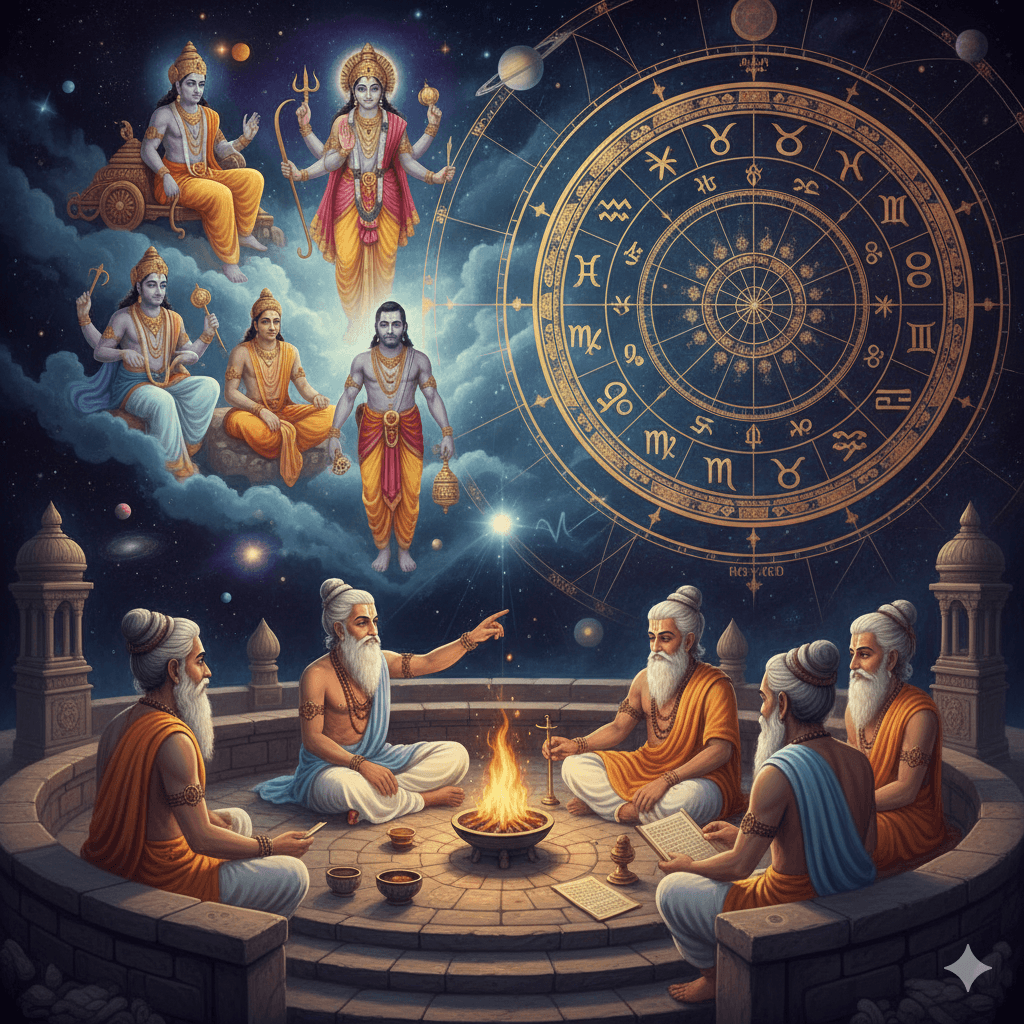
The genesis of Vedic astrology lies deeply embedded within the Vedas themselves, the oldest scriptures in human civilization. According to historical and textual evidence, the Rigveda, one of the four primary Vedic texts composed around 1200 BCE, contains the earliest references to astronomical and astrological principles, including discussions of planetary motions, lunar cycles, solar and lunar eclipses, and cosmic influences. However, it is important to note that the Vedas themselves were not originally conceived as astrological texts; rather, they were collections of hymns, incantations, and rituals that incorporated astronomical knowledge as a necessary component of religious practice. The Vedas were transmitted orally through generations, with each family and scholar carefully preserving this sacred knowledge through memorization and ritualistic recitation.
In the remote past of Vedic civilization, there existed no distinction between astronomy and astrology; both disciplines were understood under the unified term "Jyotish," meaning the study of luminous heavenly bodies. This integrated approach reflected the ancient Indian understanding that the celestial realm and earthly existence were inextricably connected through profound spiritual and physical relationships. The astronomical references scattered throughout the Vedas demonstrate that ancient Indian sages possessed sophisticated observational capabilities and mathematical knowledge, allowing them to track planetary movements, predict eclipses, and understand the cyclical nature of celestial phenomena.

Timeline of Vedic Astrology Development from Ancient Times to Modern Era
The Vedangas and the Formal Systematization of Jyotisha
A crucial development in the formalization of Vedic astrology occurred with the recognition of Jyotisha as one of the six Vedangas (literally meaning "limbs of the Vedas"). The six Vedangas—Shiksha (phonetics), Kalpa (rituals), Vyakarana (grammar), Nirukta (etymology), Chhandas (metrics), and Jyotisha (astronomy and astrology)—were conceived as auxiliary disciplines essential for the proper study, preservation, and application of Vedic knowledge. In a metaphorical representation known as the Veda Purusha (the personified Vedas), Jyotisha was symbolically designated as the eyes of the Veda, indicating its paramount importance as the discipline through which one could "see" the true spiritual meaning embedded within the Vedas. This symbolic designation reflected the profound belief that astronomical and astrological knowledge provided essential illumination for understanding divine truth and human destiny.
The earliest comprehensive text on Vedic astrology is the Vedanga Jyotisha, traditionally attributed to the sage Lagadha. Scholars date this foundational text to approximately 1400-1200 BCE, though debates continue about its precise composition date, with some scholars proposing dates as late as 700-600 BCE. The Vedanga Jyotisha exists in two recensions—one linked to the Rigveda (containing 36 verses) and another linked to the Yajurveda (containing 43-44 verses)—reflecting its integration into the broader Vedic corpus. This text marks a significant transition in the purpose of Jyotisha: rather than merely incorporating astronomical observation into rituals, the Vedanga Jyotisha was specifically designed to calculate and determine the most auspicious times for performing Vedic sacrifices and religious ceremonies. The text provided sophisticated methods for timekeeping, including a five-year cycle called a Yuga, which was subdivided into 67 lunar sidereal cycles, 1,860 tithis (lunar dates), and calculations for solstices, seasons, and omitted lunar months.

Structure of Vedic Astrology: Jyotisha Within the Six Vedangas and the Three Skandhas
Early Classical Development: Astronomical Precision and Mathematical Innovation
While the Vedanga Jyotisha focused primarily on timekeeping for rituals, subsequent centuries witnessed the development of more mathematically rigorous astronomical texts that laid the groundwork for predictive astrology. The Surya Siddhanta, a monumental astronomical treatise probably composed in the 5th century CE, exemplifies the extraordinary mathematical and astronomical achievements of ancient Indian scholars. This text employed sophisticated methods including trigonometric functions, spherical geometry, and complex mathematical calculations to determine planetary positions, predict eclipses, and measure celestial dimensions with remarkable precision.
The astronomical calculations preserved in the Surya Siddhanta demonstrate the exceptional accuracy achieved by ancient Indian astronomers. The text calculated planetary orbital periods with astonishing precision: for example, the sidereal period of the Moon was calculated as 27.322 days, compared to the modern value of 27.32166 days—a discrepancy of only 0.00066 days. Similarly, the sidereal periods of other planets calculated in the Surya Siddhanta showed comparable accuracy to modern astronomical measurements. The text also developed methods for calculating the Earth's axial tilt (obliquity), eclipse predictions through understanding the conjunction of celestial bodies at lunar nodes, and the angular positions of planets relative to Earth and the horizon at different times of day and year. These mathematical innovations provided the computational foundation upon which later predictive astrology would be constructed.
The Transition to Horoscopic Astrology: Hellenistic Influences and Indian Integration
A pivotal transformation in Vedic astrology occurred during the early centuries of the Common Era, when Greek horoscopic techniques entered the Indian subcontinent through trade routes and cultural exchange. The Yavanajataka (literally "nativity according to the Greeks"), originally translated from Greek into Sanskrit by Yavanesvara ("Lord of the Greeks") around 149-150 CE and later versified by Sphujidhvaja in 269-270 CE, represents the first substantial evidence of Greek astrological influence on Indian practices. However, scholarly debate continues regarding whether Vedic astrology merely borrowed Greek techniques or whether it represented an integration of multiple astrological traditions, including Babylonian and Egyptian influences.
The integration of Greek horoscopic methods with existing Indian astronomical and philosophical traditions fundamentally altered the purpose and scope of Jyotisha. Whereas earlier Vedic astrology had focused on determining auspicious timings for rituals and understanding cosmic rhythms, the introduction of horoscopic techniques enabled the development of natal astrology—the detailed analysis of an individual's birth chart to reveal personality traits, life events, karmic patterns, and spiritual destiny. This transformation from a calendrical and ritual science to a predictive and personal guidance system represents one of the most significant evolutionary developments in the history of Vedic astrology.
The Classical Medieval Period: Systematization and Elaboration
The medieval period (approximately 600-1600 CE) witnessed the flourishing of comprehensive classical texts that synthesized Greek, Persian, and indigenous Indian astrological knowledge into sophisticated systems of predictive astrology. Among the most important figures of this era was Varahamihira (6th century CE), a polymath astronomer, mathematician, and astrologer whose works profoundly influenced the development of classical Indian astrology. Varahamihira authored the Panchasiddhantika, which synthesized five earlier astronomical treatises and advanced methods for calculating planetary positions and predicting eclipses. More significantly for the history of astrology, Varahamihira authored the Brihat Jataka (also known as the Hora Shastra), which systematized birth chart analysis, astrological prediction techniques, and the interpretation of planetary positions and their influence on human affairs.
However, the most foundational text of classical Vedic astrology is the Brihat Parashara Hora Shastra (BPHS), traditionally attributed to the legendary sage Maharishi Parashara, though scholars debate its actual composition date. While some traditions hold that Parashara lived during the Mahabharata era (making the text thousands of years old), most scholarly consensus places the first written version of BPHS sometime after 600 CE, with the purva-khanda (earlier section) composed between 600-750 CE. Despite debates about its authorship and dating, BPHS is universally recognized as the foundational text of Vedic natal astrology, containing comprehensive descriptions of astrological principles, 144 bhava yogas (planetary combinations), dasha systems, and predictive techniques that remain central to Vedic astrological practice today.
The BPHS introduced or extensively elaborated upon crucial concepts that define Vedic astrology, most notably the Vimshottari Dasha system—a 120-year cyclical system of planetary periods that reveals the timing of major life events and karmic unfoldings. This text also developed the sophisticated system of divisional charts (Varga system), wherein the natal chart is divided into 16 different fractional divisions (such as the Navamsa or D9 for marriage and dharma, and the Dashamsa or D10 for career) to reveal subtle layers of destiny and life areas.
During this same classical medieval period, other important texts emerged to further refine and expand astrological knowledge. Kalyana Varma authored the Saravali, while Mantreswara composed the Phaladeepika, texts that explored yogas (auspicious planetary combinations), doshas (astrological afflictions), and detailed birth chart analysis. These medieval compilations incorporated learning from Greek, Persian, and Babylonian traditions while maintaining the core spiritual philosophy and karmic framework that distinguished Indian astrology from its western counterparts.
The Structure and Three Branches of Jyotisha
To fully understand the origins and development of Vedic astrology, it is essential to recognize its division into three main branches or Skandhas, each with distinct purposes and methodologies. The Ganita Skandha comprises mathematical astronomy, including the technical computation of planetary positions, orbital mechanics, eclipse predictions, and spherical geometry—the purely computational dimension of astrology. The Hora Skandha encompasses predictive astrology for individuals and specific inquiries, including Jataka (natal astrology), Prashna (query astrology based on the time a question is asked), Muhurta (the determination of auspicious moments for beginning activities), and Nimitta (the reading of omens and natural signs). The Samhita Skandha addresses mundane astrology, focusing on collective phenomena including weather predictions, natural disasters, political events, and broader societal changes. This tripartite structure emerged gradually over centuries, with the earliest texts focusing primarily on Ganita (mathematical astronomy) and the transition to personal predictive astrology occurring through Greek influences and subsequent elaboration by medieval Indian scholars.
The Distinctive Philosophical Foundations: Karma, Dharma, and Destiny
What distinguishes Vedic astrology from its Western counterpart is not merely technical methodology but a profound philosophical framework rooted in the concepts of karma (action and its consequences) and dharma (righteous duty and life purpose). Vedic astrology emerged from and remains embedded within Hindu philosophical traditions that conceive of human existence as a cyclical process of spiritual evolution across multiple lifetimes. According to this worldview, an individual's birth chart represents a cosmic blueprint—a detailed map of karmic patterns accumulated from past lives, current life circumstances, and the spiritual lessons the soul has chosen to learn in the present incarnation. The planetary positions at the moment of birth are not random occurrences but rather precise reflections of karmic destiny, encoding the soul's accumulated debts, current opportunities for growth, and future spiritual unfoldment.
This karmic philosophy fundamentally shaped the development of Vedic astrology's techniques and interpretive frameworks. The system recognizes three categories of karma: Sanchita Karma (accumulated karma from all past lives), Prarabdha Karma (the portion of accumulated karma activated in the current life through birth circumstances and early challenges), and Agami Karma (karma being actively created through present choices and actions). This tripartite understanding of karma provides a sophisticated model in which individuals are neither entirely predetermined by past actions nor entirely free to create their future, but rather participate in a dynamic interplay between inherited karmic patterns and present conscious choice.
The Sidereal Zodiac and Nakshatras: Astronomical Foundations of Vedic Astrology
A distinctive feature of Vedic astrology that reflects its astronomical origins is the use of the sidereal zodiac rather than the tropical zodiac employed in Western astrology. While Western astrology measures planetary positions against the movement of the Sun relative to the spring equinox (a moving reference point), Vedic astrology measures planetary positions against the fixed background of stars—the actual constellations visible in the night sky. This fundamental difference results in a mathematical adjustment called ayanamsa (currently approximately 24°) between the two systems, meaning that a person born on a given date in the Western astrological calendar would be assigned to a different zodiac sign in the Vedic system.
The Vedic system also employs a sophisticated system of 27 nakshatras (also called lunar mansions or asterisms), which divide the zodiacal circle into 27 equal segments of 13 degrees and 20 minutes each. Each nakshatra is associated with specific stars or asterismic patterns and carries distinct astrological significations, psychological attributes, and spiritual meanings. The nakshatras were introduced by ancient Indian astronomers and astrologers and represent an important refinement of the twelve-sign zodiac, providing more nuanced astrological analysis by indicating the precise lunar mansion in which various planets and points are located. This system of 27 nakshatras reflects the approximately 27.27-day sidereal orbital period of the Moon—the time it takes the Moon to complete one full orbit around the Earth relative to the fixed stars. The accuracy and sophistication of nakshatra calculations demonstrate how deeply Vedic astrology was grounded in precise astronomical observation and mathematical calculation.
The Medieval Suppression and Modern Revival
The flourishing of Vedic astrology during the classical medieval period was interrupted by the arrival of European colonial powers, particularly the British Empire. During the colonial period (roughly 1800-1950), Western scientific materialism and Christian religious perspectives stigmatized astrology as superstition and encouraged its abandonment among educated Indians. Traditional knowledge transmission was disrupted as colonial education systems emphasized Western science over indigenous Indian sciences, and the social prestige associated with astrology declined significantly. Despite this suppression, Vedic astrology never completely disappeared, preserved through traditional lineages of scholars and practitioners who maintained the knowledge within families and religious contexts.
The twentieth century witnessed a remarkable revival of Vedic astrology, fueled by nationalist movements seeking to reclaim and valorize indigenous Indian knowledge systems and by a growing global interest in alternative spiritual and healing practices. B.V. Raman emerged as the principal architect of this revival, establishing the Indian Council of Astrological Sciences (ICAS) in the mid-twentieth century and authoring numerous works that brought Vedic astrology into the modern English-language scholarly discourse. Raman's efforts to systematize, document, and present Vedic astrology in contemporary academic language helped restore its intellectual legitimacy and accessibility to a new generation of practitioners and scholars. Contemporaneously, K.S. Krishnamurti developed the Krishnamurti Paddhati (KP), a simplified and more streamlined system of Vedic astrology that made the discipline more accessible to practitioners seeking practical astrological guidance. The emergence of computers in the latter twentieth century further accelerated the revival by automating the complex astronomical calculations previously requiring months of manual computation, democratizing access to astrological analysis.
Global Expansion and Contemporary Significance
In recent decades, Vedic astrology has experienced unprecedented global expansion, transcending its geographical origins in India to become a worldwide practice engaging millions of adherents across diverse cultures and spiritual traditions. The internet and digital technologies have played crucial roles in this globalization, enabling practitioners to access astrological knowledge, consult with distant astrologers through online platforms, and participate in international communities of astrological learning and practice. The broader New Age movement and increasing interest in holistic health, wellness, and spirituality have also contributed significantly to Vedic astrology's contemporary resurgence in Western countries. Yet despite this modernization and globalization, the fundamental philosophical frameworks, astronomical principles, and interpretive techniques developed over millennia remain central to contemporary Vedic astrological practice, demonstrating the enduring power and relevance of this ancient science.
Conclusion: A Living Tradition Grounded in Ancient Wisdom
The origins of Vedic astrology represent a remarkable intellectual and spiritual achievement of ancient India, reflecting sophisticated astronomical observation, profound mathematical innovation, and deep philosophical insight into the nature of karma, destiny, and human spiritual evolution. Emerging from the earliest Vedic period as an integrated discipline for understanding cosmic rhythms and determining auspicious times for sacred rituals, Vedic astrology evolved through centuries of refinement, external cultural influences, and philosophical elaboration into a comprehensive system of personal and collective guidance. The foundational texts—from the Vedanga Jyotisha through the Surya Siddhanta to the Brihat Parashara Hora Shastra and classical medieval treatises—represent cumulative layers of knowledge accumulated by countless generations of observant astronomers, contemplative philosophers, and dedicated scholars.
What distinguishes Vedic astrology from other astrological systems and what explains its resilience and continued relevance across millennia is its grounding in both rigorous astronomical science and profound spiritual philosophy. Rather than merely predicting events or categorizing personality types, Vedic astrology offers a comprehensive framework for understanding human life as a manifestation of karma and as an opportunity for spiritual growth and evolution. Its integration of mathematical precision, astronomical observation, and spiritual wisdom created a system that could adapt to new knowledge and cultural influences while maintaining core principles that have proven meaningful to countless individuals seeking guidance, understanding, and connection to the cosmic order.
References
- https://www.indastro.com/learn-astrology/history-vedic-astrology.html
- https://www.scribd.com/document/850536743/Ancient-Indian-astrology
- https://astrowala.com/history-of-vedic-astrology-in-india-how-it-evolved/
- https://www.scribd.com/document/771765122/Vedic-Astrology
- https://www.exoticindiaart.com/book/details/astrology-in-vedas-nar483/
- https://en.wikipedia.org/wiki/Hindu_astrology
- https://himalayanastrology.org/vedic-astrology/
- https://palashthhakur.com/the-origins-of-vedic-astrology-unlocking-the-secrets-of-karma-kundali-and-cosmic-wisdom
- https://oaji.net/pdf.html?n=2016%2F1707-1477986558.pdf
- https://vajiramandravi.com/upsc-exam/vedangas/
- https://en.wikipedia.org/wiki/Vedanga_Jyotisha
- https://dharmawiki.org/index.php/Vedanga_Jyotisha_(%E0%A4%B5%E0%A5%87%E0%A4%A6%E0%A4%BE%E0%A4%99%E0%A5%8D%E0%A4%97%E0%A4%9C%E0%A5%8D%E0%A4%AF%E0%A5%8B%E0%A4%A4%E0%A4%BF%E0%A4%B7%E0%A4%AE%E0%A5%8D)
- https://www.worldwidejournals.com/international-journal-of-scientific-research-(IJSR)/recent_issues_pdf/2014/April/April_2014_1396444412_131fa_10.pdf
- https://meda.foundation/surya-siddhanta-legacy-innovations-and-modern-relevance/
- https://en.wikipedia.org/wiki/Surya_Siddhanta
- http://greekasia.blogspot.com/2019/07/greek-influence-on-indian-astronomy-and.html
- https://www.scienceoflight.net/science-of-light-course/classical-vedic-astrology/vedic-greek-comparison/
- https://en.wikipedia.org/wiki/Yavanajataka
- https://prepp.in/news/e-492-varahamihira-6th-century-ancient-india-history-notes
- https://vedicmathschool.org/varahamihira/
- https://en.wikipedia.org/wiki/Brihat_Parashara_Hora_Shastra
- https://www.scribd.com/doc/244404499/Brihat-Parashara-Hora-Shastra
- https://astrosure.ai/insights/blogs/decoding-the-authenticity-of-the-brihat-parasara-hora-sastra
- https://popularvedicscience.com/astrology/
- https://astropatri.com/astrological-blogs/role-of-karma-in-vedic-astrology/
- https://madhivanan.in/tropical-zodiac-settings/
- https://timenomad.app/posts/astrology/philosophy/2024/08/03/the-nakshatras.html
- https://www.melooha.com/blog/astrology-and-its-evolution
- https://www.meer.com/en/83562-western-vs-vedic-astrology-key-differences-explained
- https://www.hinduismtoday.com/magazine/october-november-december-2015/2015-10-educational-insight-jyotisha-hindu-astrology/
- https://openpathshala.com/astrology
- https://hinduamerican.org/blog/5-things-to-know-about-vedic-astrology/
- https://www.scribd.com/document/782095243/Jyotish-1985-Vedanga-Jyotisa-of-Lagadha-T-S-Kuppanni
- https://5sensestours.com/surya-siddhanta/
- https://archive.org/details/vedanga-jyotisa-lagadha-kupanna-sastry-k.-v.-sarma
- https://www.templepurohit.com/jyotisha-vedanga/
- https://www.vedanet.com/karma-dna-of-our-soul/
- https://integralresearch.in/index.php/1/article/download/306/210/661
- https://jayasreesaranathan.blogspot.com/2013/05/re-yavanas-greeks-and-history-of-zodiac.html

.png&w=3840&q=75)