
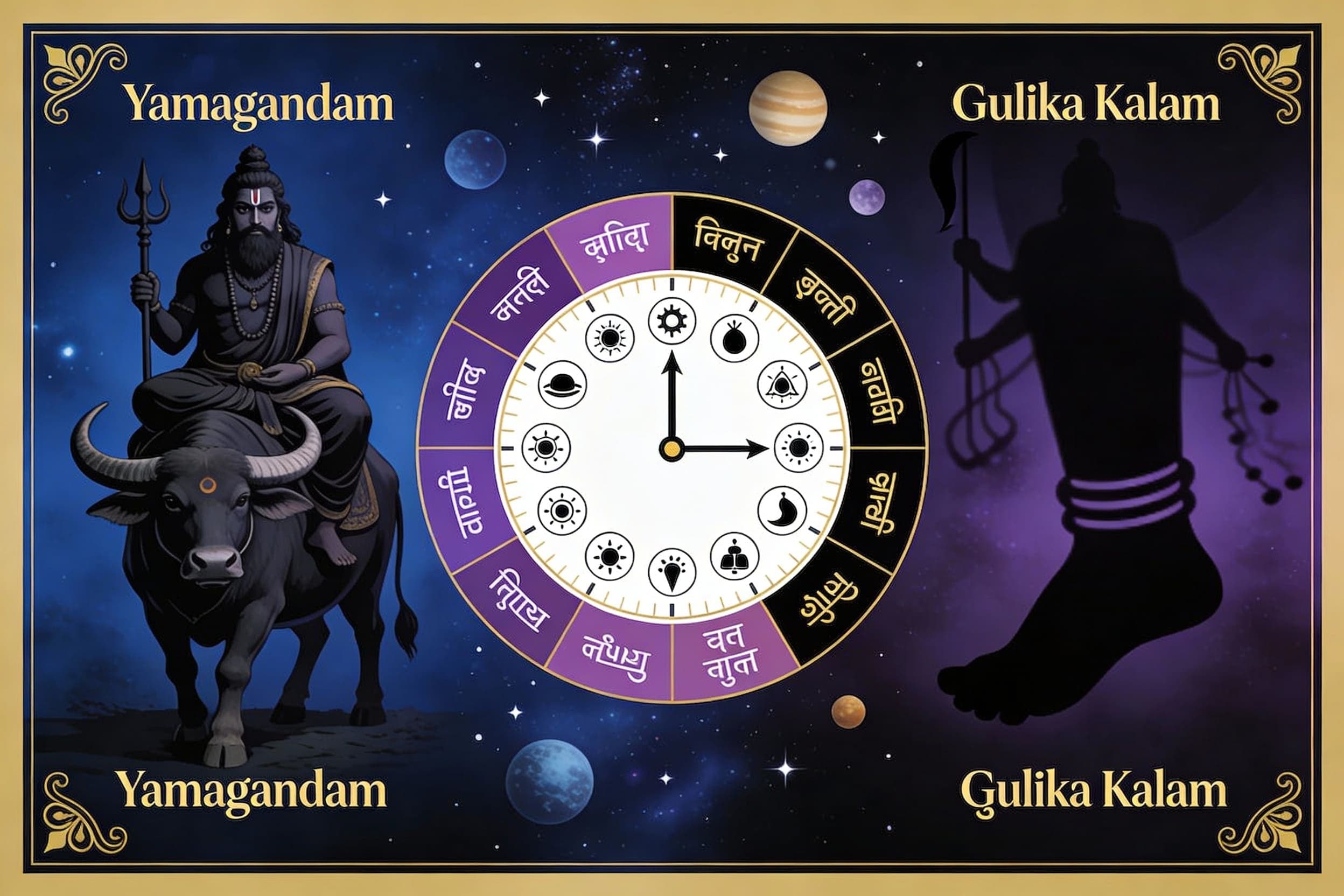
In Vedic astrology, understanding the daily rhythm of cosmic energies is essential for planning auspicious activities and avoiding periods of spiritual turbulence. Among the most significant inauspicious timings observed in the Hindu Panchang (calendar) are Yamagandam and Gulika Kalam, two distinct yet closely related periods that carry profound spiritual significance rooted in ancient scriptures and mythological traditions. While both represent times when initiating new ventures is discouraged, they differ in their planetary rulership, duration, effects, and the specific remedial measures recommended for each. This comprehensive guide explores these mystical periods, their mythological origins, practical applications, and the remedies to navigate their influence with grace and wisdom.
Daily Timing Comparison: Yamagandam, Gulika Kalam, and Rahu Kalam (Based on 6 AM Sunrise to 6 PM Sunset)

Understanding the Foundations: What Are These Inauspicious Periods?
The Concept of Inauspicious Timing in Vedic Astrology
In Vedic astrology, the day is not treated as a uniform continuum of neutral energy. Rather, the period between sunrise and sunset is divided into eight equal segments of approximately 1.5 hours each, based on the principle of dividing the daylight hours (known as "Dinamaan"). This ancient system recognizes that different planetary energies govern different time periods throughout the day, and these energies either support or hinder human endeavors. The Panchang, a traditional Hindu calendar that incorporates multiple layers of astrological information, provides guidance on the most and least favorable times for beginning important activities.
The concept of inauspicious timings extends beyond mere superstition; it represents a sophisticated understanding of cosmic rhythms and their influence on human affairs. Vedic scholars understood that certain periods carry restrictive, obstructive, or destructive energy that can undermine even the most well-planned ventures. By avoiding these periods for significant undertakings and reserving them for mundane tasks or spiritual practices, individuals align themselves with prevailing cosmic currents rather than swimming against them.
Historical and Scriptural
These timing systems find their foundation in classical Vedic texts such as the Parashara Hora Shastra and Brihat Jataka, texts that have guided astrological practice for centuries. The distribution of planetary hours follows established sequences that have been passed down through generations of Vedic astrologers, with detailed instructions for calculation and application provided in various Panchang manuals. This continuity of tradition across millennia speaks to the practical utility and perceived efficacy of these systems within Hindu culture and spiritual practice.
Yamagandam: The Time of Death and Dissolution
The Mythological Significance of Yama
Yamagandam and Gulika Kalam: Mythological and Astrological Guide
Yamagandam, also spelled "Yamakalam" or "Yama Kaal," translates to "the time of Yama," referring to Yama, the Hindu deity who serves as the Lord of Death and Justice. In the Vedic pantheon, Yama is not portrayed as a malevolent figure but rather as a divine administrator of cosmic law, responsible for guiding souls to their appropriate destinations after death. The name itself carries profound symbolic weight; Yama represents the ultimate dissolution, the ending of cycles, and the cessation of worldly endeavors. This mythological foundation explains why Yamagandam is considered such an inauspicious period for beginning new ventures—any work commenced during this time is believed to invite the "death" of that project, resulting in its failure, destruction, or permanent stagnation.
According to Vedic astrology, Yamagandam is ruled by Ketu, the South Node of the Moon, which is classified as a Chaya Graha or shadow planet. Ketu represents detachment, spiritual dissolution, and the severing of attachments to material outcomes. This association with Ketu further reinforces Yamagandam's reputation as a period when material ambitions and worldly initiatives are subject to obstruction and unfavorable outcomes.
Duration and Calculation of Yamagandam
Yamagandam occurs once daily and lasts for approximately 90 minutes, or 1.5 hours. The timing of Yamagandam is not fixed across all days; rather, it shifts throughout the week in a backward sequence, beginning on Thursday and progressing in reverse order through the remaining days. This backward progression reflects a specific planetary ordering system in Vedic astrology where the sequence of planetary hours follows the traditional planetary week but in reverse for Yamagandam specifically.
To calculate Yamagandam for any given location and date, astrologers divide the total daylight hours from sunrise to sunset into eight equal segments. Each segment corresponds to a distinct planetary influence, and the segment ruled by Ketu (or Yama) represents the Yamagandam period. Since daylight hours vary significantly with geographic location and season, Yamagandam timings are highly location-specific and time-dependent.
The standard Yamagandam timings (based on a typical 6 AM sunrise and 6 PM sunset, with each segment approximately 1.5 hours) are:
- Sunday: 12:00 PM to 1:30 PM
- Monday: 10:30 AM to 12:00 PM
- Tuesday: 9:00 AM to 10:30 AM
- Wednesday: 7:30 AM to 9:00 AM
- Thursday: 6:00 AM to 7:30 AM
- Friday: 3:00 PM to 4:30 PM
- Saturday: 1:30 PM to 3:00 PM
These timings demonstrate how Yamagandam progresses backward through the week, starting from Thursday morning and moving progressively later in the day as the week advances toward Friday and Saturday.
Effects and Implications of Yamagandam
The effects of Yamagandam are widely recognized in Hindu culture as uniformly inauspicious for initiating new endeavors. Any activity commenced during this period is believed to encounter significant obstacles, delays, or ultimate failure. Unlike some other inauspicious periods where certain activities might still proceed, Yamagandam carries the connotation of finality and destruction that makes it wholly unsuitable for positive undertakings.
The specific areas most vulnerable to Yamagandam's negative influence include:
- Travel and journeys: Both short and long-distance travel initiated during this period are believed to face complications, accidents, or unsuccessful outcomes
- Medical treatments: Beginning medical procedures or starting new health regimens is strongly discouraged
- Business and financial transactions: Signing contracts, commencing business deals, or making important financial decisions should be deferred
- Personal milestones: Events such as moving to a new residence, changing jobs, or initiating important relationships should be scheduled outside this window
- Purchases and acquisitions: Buying vehicles, property, electronics, or other significant assets is believed to result in problems with the acquired item
The only exception to the general rule of avoidance is that inauspicious activities, particularly death-related ceremonies and rituals, are traditionally performed during Yamagandam. This paradoxical use reflects the understanding that during a period already marked by dissolution and death, rituals addressing mortality and ancestral obligations align naturally with prevailing energies.
Spiritual Meaning Behind the Avoidance
Beyond the literal interpretation of negative outcomes, Yamagandam's avoidance serves a deeper spiritual purpose in Hindu philosophy. The period represents a time when the ego's attachments to worldly success are naturally loosened, and material ambitions encounter resistance from universal forces. By honoring this timing and deferring important activities, practitioners demonstrate respect for cosmic rhythms and acknowledge that not all times are equally conducive to human endeavors. This philosophical perspective transforms the practical avoidance of Yamagandam from mere superstition into a spiritual practice that aligns individual will with divine timing.
Gulika Kalam: The Repetition and Karmic Time
The Mythology of Gulika: Saturn's Shadowy Son
Gulika Kalam, also known as "Gulikai" or "Mandi Kaal," has a far more dramatic and specific mythological origin than many other astrological concepts. According to ancient Vedic scriptures, particularly references in traditional astrology texts, Gulika is considered the son of Saturn (Shani), making it a shadowy planet comparable to Rahu and Ketu.
The most elaborate mythological account of Gulika's origin appears in classical texts and describes a remarkable incident involving the demon king Ravana. The story unfolds as follows: When Ravana's son Inderjit was being born, Ravana, possessing supreme knowledge of planetary influences, attempted to position all planets in the 11th house of the birth chart, as this house is supremely auspicious for fulfilling all desires and ambitions. However, Saturn, known for its mischievous and obstructive nature, deliberately stretched one of its legs into the 12th house at the moment of Inderjit's birth, undermining Ravana's carefully orchestrated plan. The 12th house is traditionally considered inauspicious for longevity and life span.
Upon discovering Saturn's interference, Ravana flew into a rage and threw his sword at the planet, severing Saturn's leg at the point where it extended into the 12th house. This amputated portion of Saturn's leg became known as Gulika, remaining as a shadowy, disembodied force within the astrological system. Unlike complete planetary bodies, Gulika is purely a mathematical point and energetic influence, making it conceptually unique within Vedic astrology.
Ruling Planet and Energetic Characteristics
Because Gulika is understood as a fragment of Saturn, it carries Saturn's essential characteristics but in a more concentrated and potent form. Saturn (Shani) is the planet of karma, time, restriction, limitation, and slow-moving, deliberate change. Saturn's rulership extends over areas of life involving hard work, discipline, delays, and the consequences of past actions. As Saturn's son or extension, Gulika intensifies these Saturnian qualities, making Gulika Kalam a period marked by heavy, karmic, and restrictive energy.
The Gulika Kalam is understood to occur twice daily—once during daylight hours and once during nighttime—though most attention in practical astrology focuses on the daytime occurrence. This dual occurrence reflects the ongoing nature of karmic processes and the constant interplay of cosmic energies throughout the complete twenty-four-hour cycle.
Unique Characteristics: The Repetition Principle
What distinguishes Gulika Kalam from other inauspicious periods is its distinctive characteristic related to repetition and recurrence. According to Vedic astrological tradition, any activity initiated or event occurring during Gulika Kalam is believed to repeat itself in the future. This principle of karmic repetition makes Gulika Kalam simultaneously inauspicious for some activities but potentially auspicious for others, depending on the nature of the activity and the desired outcome.
This repetition principle creates a complex but pragmatic approach to Gulika Kalam:
- For inauspicious activities (particularly funerals, ancestral rites, and other death-related ceremonies): Gulika Kalam should be avoided because repeating these activities would be inappropriate and problematic. If a funeral or ancestral ritual mistakenly begins during Gulika Kalam, it is believed to require repetition once the Gulika period concludes.
- For auspicious activities (such as beginning construction of a home, starting a new business, buying property or vehicles, or initiating significant life projects): Gulika Kalam is actually considered favorable because the repetition of these auspicious acts brings enhanced blessings, prosperity, and positive outcomes.
- For marriage ceremonies: Marriage should not be performed during Gulika Kalam because repeating a marriage ceremony would be neither practical nor desirable.
This nuanced understanding of Gulika Kalam reflects a more sophisticated application of Vedic astrological principles than the blanket prohibition seen with Yamagandam.
Duration and Calculation of Gulika Kalam
Like Yamagandam, Gulika Kalam lasts approximately 90 minutes (1.5 hours) and is calculated by dividing the daylight hours from sunrise to sunset into eight equal segments. The key difference lies in the distribution sequence: whereas Yamagandam follows a backward progression through the week, Gulika Kalam's position is determined by Saturn's rulership and follows a distinct pattern.
The standard Gulika Kalam timings (based on a typical 6 AM sunrise and 6 PM sunset) are:
- Sunday: 3:00 PM to 4:30 PM (7th segment)
- Monday: 1:30 PM to 3:00 PM (6th segment)
- Tuesday: 12:00 PM to 1:30 PM (5th segment)
- Wednesday: 10:30 AM to 12:00 PM (4th segment)
- Thursday: 9:00 AM to 10:30 AM (3rd segment)
- Friday: 7:30 AM to 9:00 AM (2nd segment)
- Saturday: 6:00 AM to 7:30 AM (1st segment)
Saturn, as the planet governing Gulika, begins its weekly cycle on Saturday (the traditional day of Saturn) and progresses backward through the preceding days. This backward movement from Saturday through Friday creates the distinctive pattern where Gulika Kalam occurs progressively earlier in the day as one moves from Saturday toward Thursday, then jumps to afternoon times on the remaining days.
Regional and Cultural Variations in Understanding Gulika
It is important to note that interpretation of Gulika Kalam varies significantly across different regions and communities within India. In certain parts of Gujarat, for instance, Gulika Kalam is viewed with less severity and is sometimes considered neutral or even favorable for auspicious activities. However, in South India, particularly in Kerala and Tamil Nadu, the principle of repetition is interpreted very literally, and Gulika Kalam is approached with greater caution.
Tamil communities, in particular, emphasize the doubling or repetitive nature of Gulika Kalam, making them more cautious about initiating any activity during this period. These regional variations demonstrate how Vedic astrological principles adapt to local interpretations while maintaining their core philosophical foundation.
Comparative Analysis: Yamagandam versus Gulika Kalam versus Rahu Kalam
Key Differences in Nature and Effect
While Yamagandam, Gulika Kalam, and Rahu Kalam are often discussed together as the three primary inauspicious periods in the Panchang, each possesses distinct characteristics that merit careful distinction:
AspectYamagandamGulika KalamRahu Kalam
Ruling Force
Ketu (South Node)
Gulika (Saturn's amputated leg)
Rahu (North Node)
Nature of Influence
Death, dissolution, destruction
Karmic repetition, restriction
Desire, attachment, confusion
Primary Effect
Work/projects "die" or fail completely
Activities repeat in future
Confusion, delays, lack of success
Duration
90 minutes daily
90 minutes daily
90 minutes daily
Best Astrological Text
Various Hora texts
Parashara Hora Shastra
Classical Vedic texts
Regional Emphasis
Universal across India
Strong in South India, especially Kerala
Observed universally
Yamagandam represents the most absolute form of inauspiciousness, as the death of work implies utter failure or complete stagnation with no possibility of remediation. Its energy is associated with finality and irreversible outcomes.
Gulika Kalam, by contrast, carries heavy Saturnian restriction and slowness but offers the possibility of transformation through repetition and karmic processing. Its energy is dense and slow-moving but not necessarily destructive in an absolute sense.
Rahu Kalam represents confusion, negative thinking, increased desires, and lack of success. Its influence affects the mind and creates mental turbulence that undermines clear decision-making and successful execution of projects.
Timing Distribution Throughout the Week
The three inauspicious periods follow different progression patterns throughout the week, which sometimes creates overlap and occasionally provides small windows where none of the three periods occur. Understanding these patterns allows individuals to identify the most favorable times for important activities by process of elimination.
The backward progression of Yamagandam, the structured distribution of Gulika Kalam based on Saturn's rulership, and the specific pattern of Rahu Kalam create a complex but navigable system. In practice, many individuals consult digital Panchang applications or traditional Panchang calendars to quickly identify these timings for their specific location.
Practical Application: What Should Be Avoided and What Can Be Done
Activities to Avoid During Yamagandam
The strict prohibition of Yamagandam makes avoidance straightforward in application:
Strictly Avoid During Yamagandam:
- Commencing long-distance or important travel
- Scheduling surgical procedures or medical treatments
- Signing contracts, legal documents, or important agreements
- Initiating business ventures or starting new employment
- Beginning construction projects or home renoveries
- Purchasing vehicles, property, or significant assets
- Scheduling marriage ceremonies or important personal rituals
- Starting educational pursuits or formal learning
- Performing important financial transactions
Activities That Can Continue During Yamagandam:
- Mundane household chores and cleaning
- Routine administrative tasks like email organization
- Existing projects that were started before Yamagandam
- Meditation and spiritual introspection (some traditions recommend this)
- Reading and personal study
- Rest and relaxation
The principle underlying this distinction is that Yamagandam's destructive energy specifically targets newly initiated activities while not affecting ongoing endeavors.
Activities to Approach with Discernment During Gulika Kalam
Gulika Kalam's application requires more nuanced judgment based on the specific nature of the activity:
Potentially Favorable During Gulika Kalam (due to repetition principle):
- Construction of homes or real estate development
- Buying property, land, or significant assets where repetition (durability) is desirable
- Starting businesses or long-term ventures intended to flourish repeatedly
- Initiating projects meant to have lasting, compounding benefits
- Planting seeds or beginning agricultural activities
Should Avoid During Gulika Kalam:
- Funeral and death rites (which must not be repeated)
- Ancestral worship (Pitru Karma), which if begun in error must be repeated
- Marriage ceremonies (repetition inappropriate)
- Any inauspicious activity or rites
Neutral or Flexible During Gulika Kalam:
- Routine daily activities without specific auspicious intent
- Ongoing projects started outside Gulika Kalam
- General business operations for established enterprises
Best Practices for Working with These Periods
1. Use Digital Tools for Accuracy: Modern Panchang applications automatically calculate Yamagandam, Gulika Kalam, and Rahu Kalam based on location, providing precise timings that account for actual sunrise and sunset variations. Applications like Align27 and various astrology software provide reliable calculations.
2. Plan Activities in Advance: For important activities, schedule them outside all three inauspicious periods. In many locations, there are sufficient hours in the day to find favorable windows for important undertakings.
3. Consult Traditional Calendars: Gowri Panchang and other traditional Vedic calendars provide additional auspicious periods like Abhijit Muhurta (midday) which sometimes fall outside all inauspicious periods and carry special significance.
4. Combine with Natal Chart: For critical decisions involving life events, consult with a qualified Vedic astrologer who can examine both the daily Panchang and an individual's natal birth chart (Janma Kundali) to provide personalized guidance.
5. Emergency Situations: In genuine emergencies where activities cannot be postponed, various remedial practices (discussed below) can be performed to mitigate negative influences.
Remedial Practices and Spiritual Protection
Remedies for Yamagandam: Honoring Ketu and Yama
Although Yamagandam cannot be "canceled," its influence can be mitigated through sincere spiritual practice and ritual. The remedies work not by reversing Yamagandam's effect but by inviting protective grace and higher consciousness to supervise the activity.
Mantra Recitation for Ketu Remedies:
The most powerful remedy involves chanting Ketu's Beej (seed) Mantra, which directly addresses the planetary force governing Yamagandam:
Ketu Beej Mantra: ॐ स्रां स्रीं स्रौं स: केतवे नमः
(Om Sraam Sreem Sraum Sah Ketave Namah)
Ketu Gayatri Mantra: ॐ पद्मपुत्राय विद्महे अमृतेशाय धीमहि तन्नो केतु: प्रचोदयात्
(Om Padmputraya Vidmahe Amriteshaya Dheemahi Tanno Ketu Prachodayat)
These mantras should be chanted:
- Frequency: 108 times or in multiples (traditional practice recommends 23,000 repetitions for complete remedy, divided into 11-day cycles)
- Best Days: Tuesdays and Saturdays carry Ketu-related energy
- Best Time: Morning hours with fresh mind and focused intention
- Seated Position: Sit on a red cloth or seat, facing east or north
Worship and Deity Connection:
- Worship Lord Ganesha: Chanting "Om Gam Ganapataye Namah" 108 times invokes Ganesha's wisdom and removes obstacles
- Worship Lord Shiva: The Shiva Panchakshari Mantra (ॐ नमः शिवाय) provides spiritual protection
- Connect with Lord Hanuman: Hanuman Chalisa or Hanuman prayers on Tuesdays bring courage and spiritual strength during challenging periods
Gemstone Recommendations:
- Hessonite (Gommed): Traditionally recommended for Rahu's influence, but can provide energetic support
- Blue Sapphire (Neelam): Strengthens Saturn's disciplinary influence and provides protection
These gemstones should be:
- Worn as rings on the appropriate finger (ring finger for Ketu-related stones, often)
- Energized during appropriate planetary hours
- Obtained from reputable astrologers who can verify authenticity
Ritual and Puja Practices:
- Keta Graha Shanti Puja: Full Vedic rituals performed by qualified priests involving mantra chanting, fire offerings (Havan), water oblations (Tarpan), and feeding Brahmins (Brahmin Bhojan)
- Specific Poojas: Some traditions recommend Kala Sarpa Dosha Nivarana Pooja when Ketu's influence is particularly strong
These complete rituals provide protection for 10-15 years, making them suitable for individuals with significant Ketu challenges.
Remedies for Gulika Kalam: Invoking Saturn's Grace
Because Gulika is Saturn's extension, remedies focus on appeasing Saturn (Shani) and transforming Saturn's restrictive energy into wisdom and perseverance:
Saturn Mantra Practices:
Shani Beej Mantra: ॐ प्रां प्रीं प्रौं सः शनैश्चराय नमः
(Om Praam Preem Proum Sah Shanaishcharaye Namah)
Shani Gayatri Mantra: ॐ छयाय विद्महे वैतालिकाय धीमहि तन्नो शनि: प्रचोदयात्
Chanting practice:
- Frequency: 23,000 times for complete remedy (92,000 in Kalyuga following traditional prescriptions)
- Best Day: Saturdays, preferably in Saturn Hora (the planetary hour of Saturn)
- Best Nakshatra: Pushya, Anuradha, or Uttara Bhadrapada (Saturn's nakshatras)
Saturn Worship Practices:
- Lord Shani Worship: Offer mustard oil, black lentils, and sesame oil to Saturn's image or at a Saturn temple
- Hanuman Worship: Since Hanuman is considered a friend of Saturn, worshiping Hanuman with the Hanuman Chalisa reduces Saturn's negative effects
- Radha-Krishna Worship: Divine love and devotion neutralize Saturn's harsh influence
Fasting as Saturn Remedy:
- Saturn Fast (Shani Vrat): Fasting on Saturdays, especially during Saturn hours, purifies internal and external being and demonstrates devotion
- Diet During Fasting: Consuming only simple foods like rice, lentils, or vegetables without spices
- Frequency: Weekly or monthly depending on severity of Saturn's influence and individual capacity
Donations (Daan) for Saturn:
Items to donate on Saturdays, ideally during Saturn Hora:
- Black lentils (Sabut Urad)
- Mustard oil (Sarson Ka Tel)
- Sesame seeds (Til)
- Black clothing
- Iron tools or implements
- Male buffalo or cow (in capable communities)
Donations should be made with:
- Full faith and devotion
- No expectation of return
- Preference to worthy recipients ("Supatra")
- Clear intention to reduce Saturn's negative influence
Adi Pradakshina: The Walking Meditation:
One of the most accessible and spiritually powerful Saturn remedies is Adi Pradakshina, a meditative walking practice:
- Setup: Place a deity idol, image, or something sacred to you as the central focus
- Method: Walk slowly and deliberately in a clockwise direction around the center point
- Intention: Hold a strong intention regarding what you're struggling with or seeking help for
- Mantra: As you walk, recite: "Yani Karni Cha Paapani Janmaantara-Kritani Cha | Tani Sarvaani Nashyanti Pradakshina-Pade Pade" (With each step in this sacred circle, may the sins and burdens of this life and past lives dissolve)
- Duration: Continue for 7, 14, or 21 rounds depending on capacity and intention
- Effects: Brings peace, humility, and divine grace while systematically dissolving karmic debts
Adi Pradakshina is particularly powerful because it combines physical movement with spiritual intention, making it accessible to modern practitioners without requiring elaborate ritual preparations.
General Protective Practices for All Inauspicious Periods
Pranayama and Breathing Exercises:
Conscious breathing practices calm the nervous system and create mental clarity that helps counteract negative planetary influences. Simple techniques include:
- Alternate Nostril Breathing: Balancing left and right energetic channels
- Extended Exhale Breathing: Activating the parasympathetic nervous system
- Box Breathing: Equalizing inhalation and exhalation for mental stability
Dietary Adjustments:
- Turmeric and Cardamom: These spices carry protective and purifying properties
- Sattvic Foods: Pure, vegetarian foods in harmony with nature
- Avoid Rajasic and Tamasic Foods: Reducing meats, stimulants, and overly processed foods during difficult periods
Devotional Practices:
The most universal protection mentioned across all traditions is sincere devotion to one's chosen deity (Ishta Devata). As one saint famously sang when told of inauspicious planetary times: "The planets shall never affect the devotees of the Lord. I proceed with my duty, protected by divine grace." This principle transcends astrological calculations and places ultimate agency with spiritual consciousness rather than mechanical planetary influences.
Integrating Yamagandam and Gulika Kalam into Modern Life
Practical Strategies for Contemporary Living
In the modern world, where schedules are often fixed by institutional requirements rather than astrological considerations, rigid adherence to avoiding all three inauspicious periods can present genuine challenges. However, several practical approaches allow individuals to honor Vedic wisdom while navigating contemporary life:
1. Plan Major Life Events with Advance Notice: For predictable, important life events (weddings, relocations, business launches, surgeries), schedule them outside inauspicious periods by planning 4-6 weeks in advance. This provides sufficient time to identify favorable dates and prepare accordingly.
2. Use Flexibility for Routine Decisions: For routine activities without specific auspicious importance, the restrictions need not apply. The principle is to avoid beginning important ventures during these periods, not to cease all activity.
3. Professional Consultation for Life-Critical Decisions: For decisions that will significantly impact one's life trajectory, consulting a qualified Vedic astrologer provides personalized guidance that considers both the Panchang and individual birth chart.
4. Emergency Protocol: In genuine medical emergencies, business crises, or unavoidable situations, perform protective rituals before undertaking the necessary activity.
Astrological Software and Modern Tools
Digital Panchang Applications have revolutionized accessibility to traditional astrological knowledge:
- Align27: Provides daily Panchang with all inauspicious and auspicious timings based on GPS location
- Various Astrology Apps: Mobile applications from astrology sites offer real-time calculations of Rahu Kalam, Yamagandam, and Gulika Kalam
- Website Calculators: Many dedicated astrology websites offer free Yamagandam and Gulika Kalam calculators requiring only location and date input
These tools automatically account for:
- Seasonal variations in sunrise and sunset
- Geographic location differences
- Daylight saving time
- Real-time calculations for any date in the past or future
Cultural Continuity and Spiritual Significance
Beyond practical scheduling concerns, observing Yamagandam and Gulika Kalam serves deeper cultural and spiritual functions:
- Preserving Vedic Tradition: Following these practices connects modern practitioners to thousands of years of Hindu spiritual wisdom
- Cultivating Patience and Trust: In a world obsessed with immediate action and results, respecting cosmic timing teaches patience and faith in divine order
- Aligning with Natural Rhythms: These practices encourage synchronization with natural cycles and seasonal patterns, countering the artificial 24/7 tempo of modern life
- Developing Spiritual Awareness: Regular attention to astrological timings cultivates awareness of unseen forces and one's relationship with the cosmos
Conclusion: Wisdom in Timing
Yamagandam and Gulika Kalam represent sophisticated frameworks for understanding how cosmic energies fluctuate throughout the day and impact human endeavors. Rather than dismissing these concepts as mere superstition, modern practitioners benefit from recognizing them as empirical observations accumulated over millennia of careful attention to cause and effect. The consistent avoidance of these periods across diverse Hindu communities and geographic regions, spanning several thousand years, suggests genuine efficacy beyond placebo or cultural habit.
Yamagandam, ruled by Ketu and carrying the symbolism of Yama the Lord of Death, represents an absolute dissolution period when new projects face destruction or permanent stagnation. Its avoidance is straightforward: simply refrain from beginning important activities during this window. The remedies available focus on spiritual protection through mantra, worship, and devotional practice.
Gulika Kalam, as Saturn's shadowy extension, carries restrictive but transformative energy and follows the unique principle of karmic repetition. This makes it simultaneously inauspicious for certain activities (death rites, marriage) while potentially auspicious for others (business ventures, property acquisitions) where repetition and durability are desired.
Together with Rahu Kalam, these three periods create a daily map of cosmic influences that, when navigated with understanding and respect, can significantly enhance the success and smoothness of important human endeavors. The remedial practices—mantras, worship, donations, and meditation—provide ways not to "cheat" or circumvent these cosmic patterns but to invite divine grace and protection while proceeding with necessary activities.
For the modern spiritual practitioner, especially in a context like India where astrology remains woven into daily life, integrating awareness of Yamagandam and Gulika Kalam creates a bridge between ancient wisdom and contemporary existence. Rather than mechanical fatalism, these practices cultivate intentionality, respect for cosmic timing, and faith in a larger order that transcends individual will—a profound spiritual perspective increasingly valuable in our fast-paced, results-obsessed world.
Reference Links for Yamagandam and Gulika Kalam Blog
Core Astrology Resources on Yamagandam and Gulika Kalam
- Astrograha - Yamagandam Timings
https://astrograha.com/VedicAstrology/YamaGandam - Hindutva Online - Gulika Kalam Calculator
https://hindutva.online/gulika-kalam-calculator-understanding-the-mystical-time-period-in-vedic-astrology/ - AstroSure - What Is Yamagandam? Daily Timings and Astrological Significance
https://astrosure.ai/insights/blogs/what-is-yamagandam-daily-timings-and-astrological-significance - Pujan Pujari - Gulika Kalam Today's Timings
https://www.pujanpujari.com/gulika-kalam-today-timings/ - AstroVed - Tuesday Rahu Kalam & Yamagandam Timings
https://www.astroved.com/astropedia/en/tuesday-rahukalam-and-yamagandam-timings - AstroGiva - Yamaganadam
https://astrogiva.com/yamaganadam-2/ - AstroGiva - Gulika-Kaal
https://astrogiva.com/gulika-kaal/ - Vedic Astro Zone - Rahu Kalam Yamagandam Gulika
https://vedicastrozone.com/rahu-kalam-yamagandam-gulikan/ - Vidzone - A Complete Guide To Rahu Kalam, Yamagandam, And Kuligai In Vedic Astrology
https://vidzone.in/a-complete-guide-to-rahu-kalam-yamagandam-and-kuligai-in-vedic-astrology/ - Astrologer Govind Singh Blog - Rahu Kalam, Yamagandam and Gulika
https://astrologergovindsingh.blogspot.com/2019/10/rahu-kalam-yamagandam-and-gulika.html
Mythology and Ketu References
- Catseye.org.in - The Mysterious Ketu And Powerful Ganesha
https://catseye.org.in/blog/mysterious-ketu-powerful-ganesha/ - Cosmic Insights Blog - 5 Daily Timings To Be Avoided
https://blog.cosmicinsights.net/5-daily-timings-to-be-avoided/ - Omega Astro - Mythology about Saturn And Gulika
https://omegaastro.com/mythology-about-saturn-and-gulika/ - Instagram - Understanding Gulika Kaal: A Time of Restriction and Delay
https://www.instagram.com/p/DPoFqjfkxs3/
Saturn and Shani Remedies
- AstroSage - Saturn: Shani Mantra, Shani Puja, Shani Remedy
https://www.astrosage.com/planet/saturn/shani-mantra-shani-puja-shani-remedy.asp - Vedic Tithi - What is Rahu Kaal? Avoid Inauspicious Times in Vedic Astrology
https://vedictithi.com/learn/muhurat/what-is-rahu-kaal?lang=en - Temple of Hope - 5 Lal Kitab Remedies to Keep Rahu and Ketu Happy and Balanced in Kalyug
https://templeofhope.in/blogs/news/5-lal-kitab-remedies-to-keep-rahu-and-ketu-happy-and-balanced-in-kalyug - Cosmic Insights Blog - The Secret from Bhavishya Purana for all Saturn Related Problems
https://blog.cosmicinsights.net/secret-bhavishya-purana-saturn-remedy/ - AstroSage - Ketu Planet: Ketu Remedies & Puja Vidhi
https://www.astrosage.com/planet/ketu/ketu-mantra-ketu-puja-ketu-remedy.asp - AstroMantra - Ketu Mantra (केतु ग्रह मन्त्र)
https://www.astromantra.com/ketu-mantra/ - Align27 Blog - A Simple Ritual to Calm Saturn's Energy
https://blog.align27.com/a-simple-ritual-to-calm-saturns-energy/ - Dixith INC - Vedic Remedies, Pujas Yagyas for Ketu Graha
https://dixithinc.org/ketu-graha-shanti-remedies-to-ketu/
Ketu and Planetary Research
- Rudraksha Ratna - Ketu Planet in Astrology: Meaning, Effects, and Remedies
https://www.rudraksha-ratna.com/articles/planet-ketu-in-astrology-and-remedies
Panchang and Daily Timing Resources
- Cosmic Insights Blog - Your Day's Golden Hour for Wealth & Prosperity!
https://blog.cosmicinsights.net/your-days-golden-hour-for-wealth-prosperity/ - DuAstro - Top 6 Astrological Tips for a Balanced Daily Routine
https://duastro.com/blog/top-6-astrological-tips-balanced-daily-routine - IIAG - Daily Panchang: Auspicious Timings & Ritual Guide
https://www.iiag.co.in/articles/ng-software-blogs/daily-panchang - DuAstro - Top 6 Astrology Tips For Productive Daily Life
https://duastro.com/blog/top-6-astrological-hints-productive-schedule - Align27 Blog - Panchang: A Guide to the Hindu Calendar
https://blog.align27.com/panchang-a-guide-to-the-hindu-calendar/ - Astrology In Daily Life - The Ultimate Guide to Manage Your Day with Astrology
https://astrologyindailylife.com/the-ultimate-guide-to-manage-your-day-with-astrology/ - HisZodiac - What Is Gulika Kalam In Astrology
https://www.hiszodiac.com/astrology/what-is-gulika-kalam-in-astrology/
Additional Reference Resources
- Wealthy Matters - Gulika, Rahu Kaalam, Yamagandam & Shoolam
https://wealthymatters.com/2011/10/04/gulika-rahu-kaalamyamagandam-shoolam/comment-page-1/

.png&w=3840&q=75)